Editor’s Note
At PHAIDEA, we view semiconductors as the foundational infrastructure of the Physical AI era.
Artificial intelligence may be powered by algorithms, but its growth is ultimately constrained by the physical world. Every AI model, humanoid robot, autonomous vehicle, satellite, drone, and advanced manufacturing system depends on one critical component: semiconductors.
To understand the future of AI, industry, and geopolitics, one must first understand semiconductors.
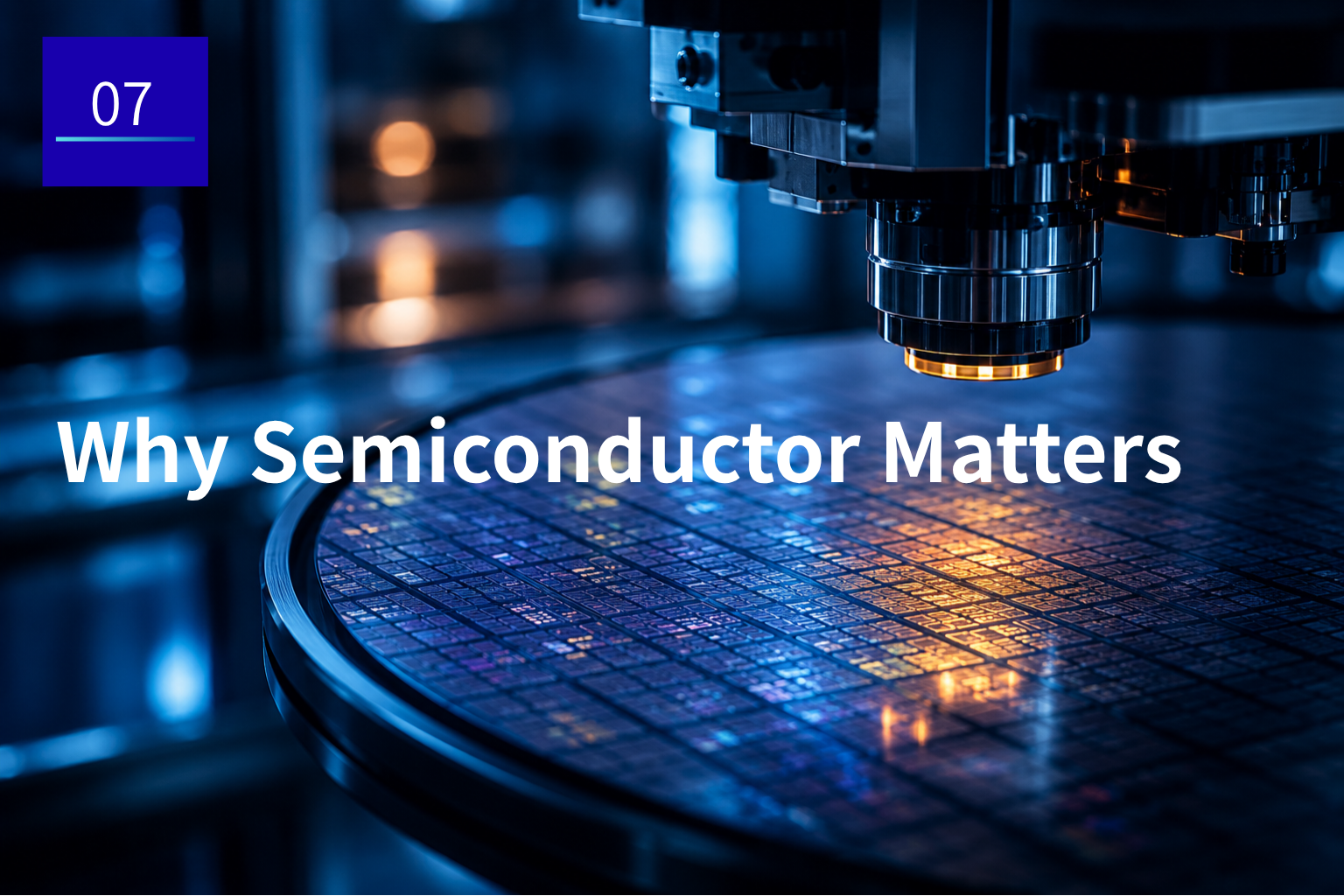
Why Semiconductor Matters
Semiconductors have become one of the most strategic assets in the modern economy.
They sit at the intersection of multiple technological megatrends. Artificial intelligence, cloud computing, robotics, autonomous vehicles, defense technology, and advanced manufacturing all depend on increasingly powerful semiconductors. As these industries expand, demand for semiconductors grows alongside them.
At the same time, semiconductors are far more than a hardware market. They form the foundation upon which new industries are built. While software companies often capture the spotlight, investment is rapidly expanding into AI infrastructure, advanced packaging, semiconductor materials, and manufacturing equipment.
NVIDIA is perhaps the clearest example of this transformation. Once known primarily as a GPU manufacturer, the company has evolved into one of the world’s most valuable enterprises as generative AI adoption accelerates. Meanwhile, supply chain software providers such as Kinaxis have benefited from the growing complexity of global manufacturing networks. Material suppliers such as JX Advanced Metals are also becoming increasingly important as demand rises for the specialized materials required to produce high-performance semiconductors.
Another defining characteristic of the semiconductor industry is its geographic concentration.
Taiwan’s TSMC, South Korea’s Samsung, and Japan’s ecosystem of material and equipment manufacturers play indispensable roles in the global semiconductor supply chain.
But why Asia?
The answer is complex. The semiconductor industry requires decades of industrial policy, talent development, capital investment, and supply chain construction. Taiwan, South Korea, and Japan have spent generations cultivating manufacturing capabilities as a matter of national strategy. The result is the competitive advantage they enjoy today.
Semiconductor competition is not only a race to build fabs and develop smaller process nodes—it is also a competition for strategic resources.
Copper, rare earth elements, gallium, germanium, nickel, and cobalt are all essential inputs for semiconductor manufacturing, while China maintains significant influence over the processing and refining of many of these materials. The strength of Taiwan, South Korea, and Japan is rooted not only in industrial policy and manufacturing expertise, but also in their proximity to Asian resource and supply networks, including those connected to China and Southeast Asia.
Looking ahead, the next phase of semiconductor geopolitics may be shaped not only by control of mines and refining capacity, but also by access to deep-sea mineral resources. As countries explore the commercial potential of seabed mining, competition over strategic materials could become an increasingly important dimension of technological and economic power.
At the same time, the industry faces significant challenges.
The pace of transistor scaling is approaching physical limits, while manufacturing costs continue to rise sharply. As a result, researchers are exploring next-generation technologies such as advanced packaging, photonic computing, quantum computing, neuromorphic semiconductors, and novel materials.
Meanwhile, geopolitical tensions, energy constraints, talent shortages, and supply chain fragmentation continue to intensify.
The future of semiconductors will not be determined by technological innovation alone. Capital, industry, resources, and policy will collectively shape the next era of competition.
For this reason, semiconductors are no longer simply a technology sector.
Semiconductor are becoming the critical infrastructure for the Physical AI era.
– PHAIDEA Editorial team