Editor’s Note
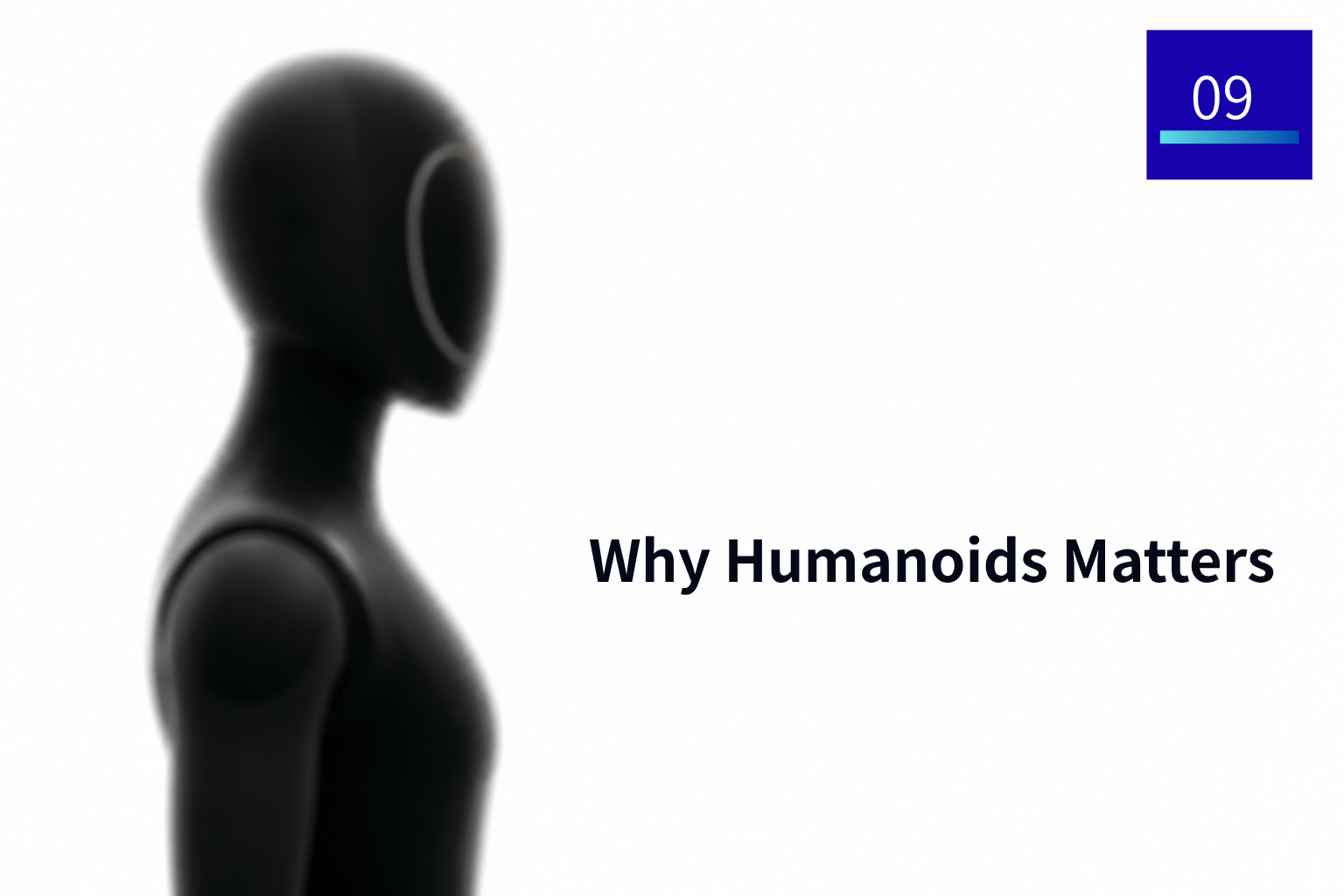
At PHAIDEA, we view humanoid robots as far more than a new category of machines.
They represent the convergence of artificial intelligence, robotics, manufacturing, energy, and human society itself. As nations confront aging populations, labor shortages, and rising productivity demands, humanoids are emerging as one of the most ambitious attempts to redefine work in the twenty-first century.
Understanding humanoids means understanding the future of industry.
Value of Humanoids
Humanoid robots have long existed in research laboratories and science fiction. Today, they are becoming a strategic industrial priority.
Advances in foundation models, computer vision, embodied AI, batteries, and electromechanical systems have transformed humanoids from experimental machines into commercially viable platforms. Companies including Tesla, Figure AI, Agility Robotics, Sanctuary AI, and 1X are accelerating development, while governments increasingly recognize humanoids as part of broader industrial competitiveness.
From an investment perspective, humanoids represent far more than a robotics market. They have the potential to create entirely new ecosystems spanning semiconductor design, AI infrastructure, precision manufacturing, sensors, software, logistics, healthcare, insurance, maintenance, and workforce transformation. Much like smartphones created new industries beyond mobile devices, humanoids may become the next general-purpose platform for the physical economy.
Academic researchers view humanoids as one of the most demanding frontiers in artificial intelligence. Unlike large language models operating in digital environments, humanoids must perceive uncertain physical surroundings, reason under real-world constraints, manipulate objects safely, and continuously learn from experience. Their development requires the integration of AI, neuroscience, biomechanics, materials science, and human-computer interaction, making humanoids one of the most interdisciplinary engineering challenges of our time.
Their emergence also introduces significant regulatory questions. As humanoids enter factories, hospitals, public infrastructure, and eventually private homes, governments must establish standards for functional safety, cybersecurity, liability, data privacy, and human oversight. Future certification systems may resemble those governing automobiles, aircraft, or medical devices, ensuring that autonomous systems can safely operate alongside people.
Different nations are approaching this opportunity in distinct ways. The United States emphasises private-sector innovation supported by venture capital and defense investment. China is scaling manufacturing capabilities while incorporating humanoids into long-term industrial strategy. Japan leverages decades of robotics expertise to address demographic challenges, while Europe focuses on ethical AI and regulatory frameworks.
Humanoids are not simply replacing labor. They are redefining how labor, intelligence, and machines interact.
At PHAIDEA, we believe the humanoid revolution is not solely about robots. It represents the emergence of a new industrial platform where capital, policy, engineering, and human society converge.
Understanding humanoids is ultimately about understanding how intelligence enters the physical world.
– PHAIDEA Editor Team